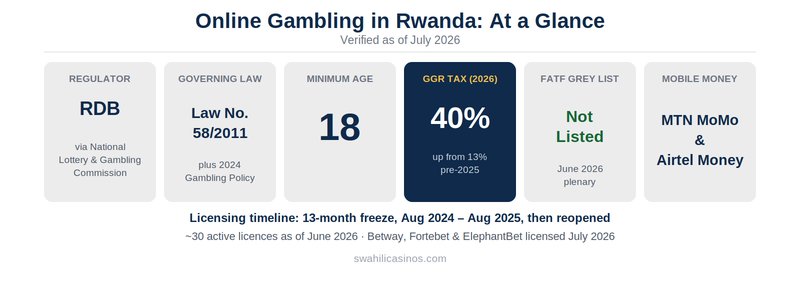
Online gambling in Rwanda is legal and regulated under Law No. 58/2011, with oversight now sitting under the Rwanda Development Board (RDB) through its National Lottery & Gambling Commission (NLGC). That regulatory picture has changed substantially since 2024: a full licensing freeze, a sweeping new gambling policy, and the steepest gambling tax increase anywhere in the region. If you’ve read a “gambling in Rwanda” guide that still names the Ministry of Trade and Industry as the regulator or quotes a 13% tax rate, it’s out of date — both changed in the last two years.
This guide covers where things actually stand in 2026, not where they stood before the 2024 policy overhaul.
Is Online Gambling Legal in Rwanda?
Yes. Gambling — land-based and online — is legal and regulated in Rwanda under Law No. 58/2011 of 31/12/2011, supported by Ministerial Order No. 01/013 of 20/06/2013 (licensing procedures and fees) and Ministerial Order No. 001/MINICOM/2023 (AML/CFT-related administrative sanctions). The minimum legal gambling age is 18.
What’s changed is who enforces it and how. Rwanda’s 2024 Gambling Policy, approved by Cabinet on 18 October 2024, transferred day-to-day regulatory authority to the Rwanda Development Board — a shift formalised by Prime Minister’s Order No. 028/03 of 28 June 2024. Older licences and older operator materials that still reference the Ministry of Trade and Industry as the regulator reflect the pre-2024 arrangement, not the current one.
Who Regulates Online Gambling in Rwanda?
The Rwanda Development Board (RDB), acting through its National Lottery & Gambling Commission (NLGC), is the current regulatory authority. The 2024 Gambling Policy sets out three pillars for how RDB approaches the sector: minimising social harm, maximising the industry’s economic contribution, and strengthening regulatory and compliance infrastructure — including plans for a dedicated National Gambling Authority and Gambling Commission as the legal framework is rebuilt around Law No. 58/2011.
That rebuild hasn’t been gentle. RDB suspended all new licence issuance and renewals for a full 13 months, from August 2024 to August 2025, specifically to design and implement the new policy. Licensing reopened on 1 August 2025, with RDB inviting Expressions of Interest for land-based sports betting, online sports betting, and online casino licences. As of June 2026, roughly 30 operators hold active licences — a smaller, more tightly vetted field than existed before the freeze. In July 2026, RDB confirmed new licences for three well-known regional and international sportsbook brands, including Betway and Fortebet, signalling that the post-freeze licensing pipeline is now genuinely moving.
One practical caveat worth being upfront about: unlike Tanzania’s GBT or Uganda’s NLGRB, RDB does not currently maintain a public, regularly updated list of licensed operators on its website. Verifying an operator’s status means checking directly with RDB or looking for a specific, checkable licence reference on the operator’s own site — treat any operator that doesn’t provide one with real caution.
How Is Gambling Taxed in Rwanda?
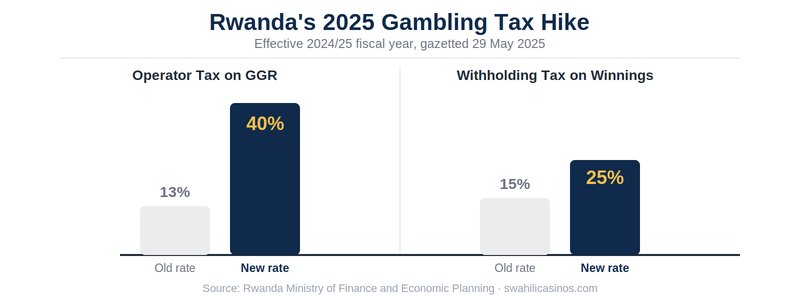
This is the single biggest change in Rwanda’s gambling market, and it’s dramatic enough that it deserves to be stated plainly: Rwanda’s Gross Gaming Revenue (GGR) tax on operators rose from 13% to 40%, and the withholding tax on player winnings rose from 15% to 25%. Both changes were enacted by Parliament and gazetted on 29 May 2025, effective for the 2024/2025 fiscal year, as part of a wider package of tax reforms tied to Rwanda’s Second National Strategy for Transformation (NST2).
| Tax | Old Rate | New Rate | Base |
|---|---|---|---|
| Gambling operator tax | 13% | 40% | Gross Gaming Revenue |
| Withholding tax on player winnings | 15% | 25% | Net winnings |
A 40% GGR tax is high even by regional standards — well above Tanzania’s 25% online GGR rate and Kenya’s operator-side tax structure. Industry analysts, including H2 Gambling Capital, have publicly warned that a rate this steep risks pushing players toward unlicensed offshore sites that don’t carry the same tax burden, which is worth knowing as context rather than as a reason to avoid licensed operators — a licensed operator’s higher costs don’t change your own legal standing as a player, but they may show up in less generous bonus terms than you’d see in a lower-tax market.
Mobile Money and Payments in Rwanda
MTN Mobile Money and Airtel Money are the two dominant mobile money platforms in Rwanda and the standard funding method at virtually every licensed operator, alongside card payments and, at some international platforms, e-wallets like Skrill and Neteller. For how these compare to the payment landscape in neighbouring markets, see our regional payment options guide. Rwanda does not impose a government levy on domestic mobile money transfers, unlike some neighbouring markets. Rwanda does not impose a government levy on domestic mobile money transfers, unlike some neighbouring markets — MTN MoMo peer-to-peer fees, for reference, range from roughly RWF 20 for small transfers up to RWF 1,500 for transfers above RWF 150,000, set by the provider rather than the state.
KYC requirements for mobile money accounts are tiered under the National Bank of Rwanda’s Regulation No. 02/2019 on digital financial services, with simplified due diligence for lower-value accounts and fuller verification required as account activity and value increase — the same tiered logic licensed gambling operators apply to deposits and withdrawals.
Rwanda and the FATF Grey List
Rwanda is not currently on the FATF grey list. As of the June 2026 FATF Plenary, the list of jurisdictions under increased monitoring included Kenya and the Democratic Republic of Congo among East and Central African states, but not Rwanda. This is a genuine, checkable point of difference from some neighbouring markets, and it reflects Rwanda’s implementation of FATF-aligned AML/CFT legislation dating back to 2008 under Law No. 47/2008. For anyone tracking cross-border payment and compliance friction as part of choosing where to play, this is a meaningfully cleaner position than Kenya’s.
What’s Changed Beyond Tax and Licensing
A few other regulatory shifts from the 2024 policy overhaul are worth knowing, since they show where Rwanda’s approach is heading rather than just where it’s been:
- Slot machines are being phased out. RDB’s policy specifically targets slot machines for removal, on the basis that they carry high social-harm risk relative to their economic contribution — a notably more aggressive stance than most East African regulators have taken on this category.
- Celebrity endorsement in gambling advertising is banned. This is part of a broader tightening of advertising rules alongside the 2024 policy’s harm-minimisation pillar.
- The national lottery has a new operator. Moja Rwanda Limited took over as Rwanda’s national lottery operator in April 2026, following an open bidding process, under a ten-year partnership agreement with RDB. Lottery proceeds are directed toward sports development, including athlete programmes and facility investment.
- Enforcement is visibly active, not just written policy. RDB has already demonstrated willingness to act against non-compliant operators — including a suspension order against Kings Bet Ltd — rather than treating the new framework as a formality.
Responsible Gambling in Rwanda
Rwanda’s 2024 Gambling Policy explicitly frames harm minimisation as one of its three core pillars, and mandates responsible gambling messaging — including the 18+ age limit — in all licensed gambling advertising. That said, there’s a real gap worth being honest about: Rwanda does not currently operate a dedicated national gambling addiction helpline. If gambling stops feeling like entertainment, general mental health support services in Rwanda can help with the underlying patterns even without a gambling-specific line to call, and it’s worth treating that as a genuine limitation of the current support infrastructure rather than something to work around.
Set a budget before you play, and treat any win as a bonus rather than an expectation — especially with a 25% withholding tax now applying directly to winnings at licensed operators.
Frequently Asked Questions
Is online gambling legal in Rwanda? Yes. Gambling is legal and regulated under Law No. 58/2011, with the Rwanda Development Board (RDB), through its National Lottery & Gambling Commission, as the current regulatory authority.
What is the gambling tax rate in Rwanda? As of the 2024/2025 fiscal year, operators pay a 40% tax on Gross Gaming Revenue (up from 13%), and players face a 25% withholding tax on net winnings (up from 15%) — among the highest gambling tax rates in the East African region.
Is Rwanda on the FATF grey list? No. As of the June 2026 FATF Plenary, Rwanda was not among the jurisdictions under increased monitoring, unlike Kenya and the Democratic Republic of Congo.
What payment methods do Rwandan gambling sites accept? MTN Mobile Money and Airtel Money are the dominant methods, with card payments and some international e-wallets also available depending on the operator.
What is the minimum age to gamble in Rwanda? 18 years old.
How do I check if an operator is licensed in Rwanda? Look for a specific, checkable RDB/NLGC licence reference on the operator’s own site. RDB does not currently publish a public, regularly updated list of licensed operators, so unlike Tanzania or Uganda, there’s no single official registry to cross-check against — treat operators that don’t cite a specific licence reference with caution.
This article is provided for informational purposes and reflects Rwanda’s gambling regulatory framework as understood as of July 2026. Regulations, tax rates, and licensing requirements can change — verify current status directly with the Rwanda Development Board before making decisions based on this information. Gambling involves financial risk. If gambling stops being enjoyable, seek support from a mental health professional or a trusted person.