Is Online Gambling Legal in Burundi?
Online gambling sits in a genuine gray area in Burundi, but the picture is shifting quickly. Burundi’s 2008–2009 Penal Code technically prohibits most forms of gambling, yet the country’s national lottery operator, LONA (Loterie Nationale du Burundi), has long operated under a government exception — and as of early 2026, LONA is actively transforming into Burundi’s dedicated gambling regulator, with a target completion date of June 30, 2026. In practice, this means a growing list of online betting and casino platforms now operate with LONA’s authorization, while unlicensed sites are increasingly being flagged rather than ignored.
For most residents, the practical reality hasn’t changed overnight: nobody has been prosecuted simply for placing a bet on an offshore site, and enforcement has historically focused on unlicensed land-based venues. But the direction of travel is unmistakable — Burundi is moving from “unregulated gray market” toward a licensed, monitored system, and that has real implications for which sites are worth using and which aren’t. It’s a pattern playing out across the region: Tanzania’s online gambling sector is undergoing a similar regulatory evolution driven by mobile-first growth and government revenue ambitions.
Burundi’s Gambling Laws: From the 2008 Penal Code to Today
The 2008/2009 Penal Code Ban
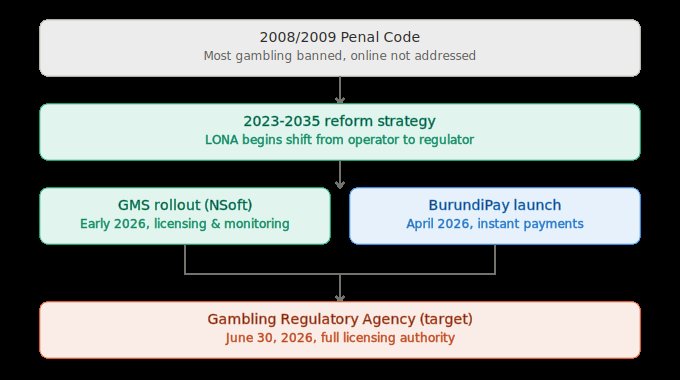
Burundi’s Penal Code (.PDF), revised in 2009, makes most forms of gambling illegal — including casino games, lotteries, and sports betting — with one long-standing carve-out: games of chance organized by LONA itself, historically for charitable or state-revenue purposes. The Penal Code doesn’t specifically address online gambling, which is precisely why so much coverage of Burundi describes it as a “gray area” — the law wasn’t written with the internet in mind, and for years there was no mechanism to license, monitor, or formally permit online operators one way or the other.
That ambiguity is the reason a single land-based casino (Lydia Ludic, in Bujumbura, opened in 2001 and jointly owned with LONA) could coexist with a blanket legal ban, and why offshore betting sites have been freely accessible to Burundian players without any reported legal consequences for individual bettors.
LONA’s Transformation Into a Gambling Regulatory Agency
This is where the situation has changed substantially — and where most existing coverage of Burundi’s gambling laws is now out of date. Since late 2025, LONA has been executing a multi-year reform under Burundi’s National Strategy for the Control and Regulation of Gambling (2023–2035). The core change: LONA is phasing out its role as a commercial lottery operator — winding down scratch tickets and gaming venues as existing concession contracts run out — and converting into a standalone Gambling Regulatory Agency responsible for licensing, compliance, and oversight across lotteries, sports betting, horse racing, and online gambling, with casino oversight to follow in later stages.
LONA’s own stated framing for this shift is explicit:
“The implementation of NSoft’s technological governance solutions to oversee the gambling sector in Burundi is a key step in our revenue-mobilization strategy and in the restoration of our digital sovereignty.”
That language signals the government’s priority is less about morality-based prohibition and more about bringing a previously untaxed, unmonitored sector under formal control. The target date for the new Gambling Regulatory Agency to be operational is June 30, 2026; as of this writing, that transition is in an active implementation phase but not yet confirmed as complete.
The Gambling Management System (GMS)
A central piece of this reform is the Gambling Management System (GMS), built in partnership with gaming technology provider NSoft. The GMS is designed to give LONA centralized, real-time visibility into player registrations, betting activity, operator turnover, jackpot payouts, and tax liabilities across licensed operators — essentially the infrastructure needed to move from “we don’t really track this” to “we license and monitor this.”
NSoft confirmed presenting its supervision framework results to LONA in late February 2026, indicating the technical groundwork is well underway. For players, the practical effect over time should be a clearer distinction between operators that are formally licensed and monitored versus those that aren’t — something that simply didn’t exist as a structured system before.
Which Online Gambling Operators Are Authorized in Burundi?
As of March 2026, LONA’s leadership publicly named a list of gambling companies currently authorized to operate in the country. This is a notable departure from the older narrative that “no online casinos are licensed in Burundi” — that framing is no longer accurate.
| Authorized Operator | Type |
|---|---|
| 1xbet | Sports betting / casino |
| Bubet | Sports betting / casino |
| 1Tbet | Sports betting |
| King’s Investment | Gambling operator |
| Megalotto | Lottery / betting |
| Sigma | Gambling operator |
| Lydia Ludic | Land-based casino (Bujumbura) |
| 888 Starz | Sports betting / casino |
| Rahisi Bet | Sports betting / limited casino slots |
At the same briefing, LONA also named several platforms it considers suspect or fraudulent and is actively monitoring — including Lumicach, Payway, Cashtel, iHela, and Bancobu e-note — and stated that informal betting houses operating outside licensing standards will be required to formalize before continuing operations. The clear message from the regulator: the era of “everything offshore is equally fine” is ending, even if enforcement is still catching up to policy.
It’s worth being precise here: this list reflects operators LONA named as authorized at a specific point in time (March 2026), during an active regulatory transition. It is not a guarantee of ongoing status, and players should treat it as a starting point for due diligence rather than a permanent or exhaustive registry.
For operators we have reviewed in depth, see our Paripesa online casino review as a reference point for what a thorough operator evaluation covers.
How Do Burundians Actually Pay for Online Gambling?
Mobile Money: Lumicash and EcoCash
Burundi’s payment landscape for online gambling — like the rest of its digital economy — runs almost entirely on two mobile money services: Lumicash (operated by telecom Lumitel) and EcoCash (operated by Econet Leo). These two providers handle the large majority of mobile money transactions in the country, with usage concentrated in urban centers like Bujumbura, Gitega, and Ngozi.
For betting platforms that support them, Lumicash and EcoCash deposits are typically processed instantly, while withdrawals commonly take anywhere from a few minutes to 24–48 hours depending on the operator, with first withdrawals often requiring KYC (identity) verification.
For a broader overview of how deposits work at online casinos, including step-by-step guidance, see our dedicated payments guide.
BurundiPay and the Shift to Instant Payments
In April 2026, the Central Bank of Burundi (BRB) launched BurundiPay, a national instant payment system enabling real-time transfers across bank accounts and mobile wallets. This followed an earlier upgrade in which the BRB migrated its Automated Transfer System to the ISO 20022 international messaging standard — a technical step toward better interoperability between banks, mobile money providers, and, per the BRB’s own framing, regulated gaming channels specifically.
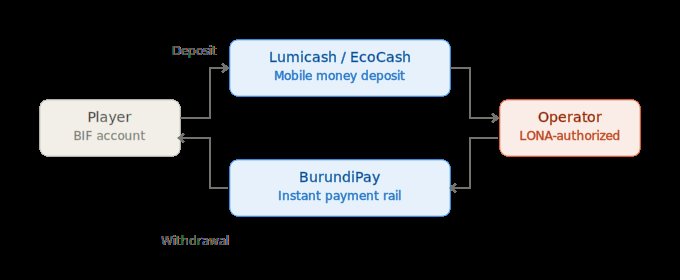
The practical significance for online gambling: as BurundiPay rolls out, the infrastructure connecting bank accounts, Lumicash, EcoCash, and licensed betting operators should become faster and more traceable — which aligns directly with LONA’s GMS-based monitoring approach. It’s a genuinely joined-up reform across the central bank and the gambling regulator, not two unrelated initiatives.
Currency Considerations (BIF vs. USD/EUR)
The Burundian franc (BIF) is the national currency, but many international gambling platforms don’t support BIF natively — accounts are often denominated in USD or EUR instead. This introduces a currency-conversion step (and potential conversion costs) for Burundian players using platforms that aren’t built around local currency and local mobile money rails. Operators that are LONA-authorized and built specifically for the Burundian market, such as Bubet, more commonly support BIF accounts directly via Lumicash and EcoCash.
| Payment Method | Typical Deposit Speed | Typical Withdrawal Speed | Notes |
|---|---|---|---|
| Lumicash | Instant | Minutes to 24–48 hrs | Requires KYC for first withdrawal on most platforms |
| EcoCash | Instant | Minutes to 24–48 hrs | Requires KYC for first withdrawal on most platforms |
| BurundiPay (emerging) | Instant (per BRB) | Not yet widely reported | Rolled out April 2026; integration with betting platforms still developing |
| Cards / international e-wallets | Instant to same-day | 1–5 business days | Common on platforms not built for BIF; currency conversion applies |
How Does Online Betting Registration Work in Burundi?
Registration on a LONA-authorized platform generally follows a standard process: create an account with a phone number and basic personal details, verify the account (often via SMS code), choose a payment method — typically Lumicash or EcoCash for BIF accounts — and complete KYC verification, usually required before a first withdrawal rather than before a first deposit.
Operators built for the Burundian market, such as Bubet, advertise account setup in French and registration completed in around a minute, reflecting the mobile-first, low-data realities of the market — connections that often run on 3G or unstable networks.
The registration process is broadly similar to what players experience on platforms in neighbouring markets; our beginner’s guide to online betting in Rwanda walks through the steps in detail if you want a fuller walkthrough.
Is It Safe to Gamble Online in Burundi? (Risks & Red Flags)
The honest answer is: it depends heavily on which platform you choose, and that gap is exactly what Burundi’s regulatory reform is trying to close. A few practical points:
LONA has publicly named specific platforms it considers fraudulent or suspect — Lumicach, Payway, Cashtel, iHela, and Bancobu e-note among them, as of March 2026. Anyone encountering these names should treat them with caution, given the regulator’s own warning.
Beyond the named list, general red flags apply regardless of country: no visible licensing information, no clear terms and conditions on bonuses, no transparent withdrawal limits, and customer support that won’t answer specific questions about KYC requirements or payment methods.
It’s also worth being clear about what’s not a red flag in Burundi specifically: using an internationally licensed offshore platform isn’t, by itself, illegal for the individual player, and there’s no record of Burundian players facing legal consequences for doing so. The risk profile for offshore platforms is more about payment reliability, currency conversion costs, and support quality than legal exposure — at least as the regulatory landscape stands during this transition period.
Responsible Gambling in Burundi
There is currently no dedicated, country-specific problem gambling helpline publicly available for Burundi — this is a genuine gap in the country’s gambling infrastructure, and readers should be aware of it rather than assume support exists where it doesn’t. LONA’s regulatory reforms include a stated focus on consumer protection as part of its licensing standards going forward, but as of mid-2026, this hasn’t yet translated into a published national support line.
In the absence of a local helpline, practical steps remain available regardless of jurisdiction: most licensed operators offer in-account tools for deposit limits, time-outs, and self-exclusion — these are worth setting up proactively, not after a problem develops. Gambling should never be treated as a source of income, and anyone concerned about their own or someone else’s gambling habits should seek support from a healthcare provider, as broader regional mental health and addiction services may be able to help even without a gambling-specific line.
If you’re researching the online gambling landscape across the wider East African region, see our dedicated country guides for casinos in Tanzania, casinos in Kenya, casinos in Uganda, and casinos in Congo (DRC) — each covers local legal status, payment methods, and operator availability in detail.
FAQ
Is online gambling legal in Burundi? It’s complicated. Burundi’s Penal Code technically bans most gambling, but LONA has authorized a specific list of operators and is actively becoming the country’s formal gambling regulator, with the transition targeted for completion by June 30, 2026. Offshore platforms remain widely accessible with no reported legal consequences for individual players.
What is LONA and what does it do? LONA (Loterie Nationale du Burundi) is Burundi’s national lottery operator, which is in the process of converting into a dedicated Gambling Regulatory Agency overseeing lotteries, sports betting, horse racing, and online gambling licensing and compliance.
Which betting sites are authorized in Burundi? As of March 2026, LONA named 1xbet, Bubet, 1Tbet, King’s Investment, Megalotto, Sigma, Lydia Ludic, 888 Starz, and Rahisi Bet as authorized operators. This list may change as the regulatory transition continues.
Can I deposit with Lumicash or EcoCash? Yes — Lumicash and EcoCash are the two dominant mobile money services in Burundi, and platforms built for the local market (such as Bubet) support both for instant deposits, with withdrawals typically taking minutes to 48 hours.
What happens if I use an unauthorized gambling site? LONA has named several platforms — Lumicach, Payway, Cashtel, iHela, and Bancobu e-note — as suspect or fraudulent as of March 2026. There’s no record of individual players facing legal action for using unauthorized sites, but the regulator’s warning suggests caution around these specific names.
Is online gambling going to change in Burundi soon? Yes, significantly. Between LONA’s transition into a formal Gambling Regulatory Agency (targeted for June 30, 2026), the new Gambling Management System for licensing and monitoring, and the April 2026 launch of BurundiPay for instant payments, Burundi’s gambling sector is moving from largely unregulated toward a licensed, monitored system faster than most current coverage reflects.
This article reflects publicly available information as of June 2026. Burundi’s gambling regulatory framework is in active transition; readers should check LONA’s official channels (lona.gov.bi) for the most current licensing status before using any platform.