Online gambling in Uganda is legal for operators licensed by the National Lotteries and Gaming Regulatory Board (NLGRB), the body established under the Lotteries and Gaming Act No. 7 of 2016. The regulatory framework is stable, well-established, and currently undergoing its most significant tax overhaul in years — a harmonised 30% GGR tax on operators and a new 15% withholding tax on player net winnings both take effect on 1 July 2026.
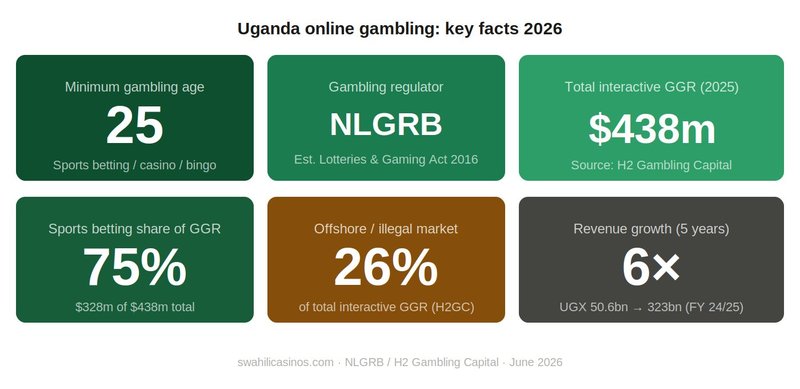
Two things distinguish Uganda’s gambling market from every other country in East Africa: the minimum legal gambling age is 25 — not 18, as is commonly misreported — and gaming revenue has grown nearly sixfold in five years, from UGX 50.6 billion (USD 13 million) in FY 2019/20 to UGX 323 billion (USD 85 million) in FY 2024/25. Both facts matter for players choosing where and how to play.
Is Online Gambling in Uganda Legal?
Yes. Online gambling is legal in Uganda, provided the operator holds a valid licence issued by the NLGRB. The Lotteries and Gaming Act 2016 explicitly covers online platforms alongside land-based betting shops and casinos. Licensed casinos in Uganda can offer sports betting, casino gaming, lotteries, and virtual games online.
Players in Uganda are legally permitted to use licensed platforms. Regulatory obligations — licensing, compliance, AML reporting, technical monitoring — fall on operators, not individual players. That said, players face a direct tax obligation on winnings from 1 July 2026 onwards (see Taxation section below), which is new.
Who Regulates Online Gambling in Uganda?
The National Lotteries and Gaming Regulatory Board (NLGRB)
The NLGRB is Uganda’s sole gambling regulator, established under the Lotteries and Gaming Act No. 7 of 2016. Its mandate covers licensing, monitoring, enforcement, and player protection for all gambling activity — online and land-based. The Board’s official website is lgrb.go.ug, and its e-licensing platform (licensing.lgrb.go.ug) handles all operator applications.
Key leadership confirmed as of mid-2026:
- Board Chairman: Kenneth Kitariko — inaugurated 2025, following the handover ceremony officiated by Finance Minister Matia Kasaija
- Chief Executive Officer: Denis Mudene Ngabirano — an IT specialist by background who has led the Board’s digital transformation since 2020
The NLGRB operates alongside several other regulatory bodies that collectively govern Uganda’s gambling sector:
| Authority | Role |
|---|---|
| NLGRB | Licensing, monitoring, enforcement of gambling law |
| Uganda Revenue Authority (URA) | Collection of gaming taxes (GGR, withholding) |
| Financial Intelligence Authority (FIA) | AML/CFT oversight — casinos must register as “accountable persons” |
| Bank of Uganda | Will licence the proposed centralised payment gateway (pending) |
| National Information Technology Authority Uganda (NITA-U) | IT certification for operator systems and data handling |
The Lotteries and Gaming Act 2016: Scope and Key Provisions
The primary legislation gives the NLGRB authority over four licence categories: lotteries, casinos, gaming, and betting. Online platforms fall under existing categories rather than requiring a separate online-specific licence — sports betting sites that also offer online casino games obtain the relevant licences for each activity type.
Key provisions for players and operators:
- Minimum capital requirement for licensing applications: UGX 250 million (approximately USD 67,000)
- All electronic gaming machines must connect to the National Central Electronic Monitoring System (NCEMS), the NLGRB’s real-time stake monitoring infrastructure
- Operators introducing new games must submit game rules for regulatory approval
- Casinos must register as accountable persons with the Financial Intelligence Authority and file annual AML/CFT compliance reports
- All key employees must pass background checks and hold relevant qualifications
- Licensed premises must maintain a minimum 100-metre distance from schools, markets, and places of worship
The Minimum Gambling Age: Uganda’s Unique Position
The minimum legal gambling age in Uganda is 25 years for casino games, sports betting, and bingo. This is confirmed directly by the NLGRB and is one of the highest minimum age thresholds for gambling anywhere in the world.
There is one exception: the National Lottery, operated under a ministerial licence for public good causes, is open to those aged 18 and above.
NLGRB CEO Denis Mudene Ngabirano has publicly stated this distinction at enforcement briefings with Uganda Police Force: “Sports betting, casino games, and bingo are strictly reserved for individuals aged 25 and above.” Operators are required to verify player age using national IDs (for Ugandans) or passports (for foreign nationals).
The practical implication: players who are 18–24 are legally excluded from sports betting and casino gaming in Uganda, regardless of whether they play at a land-based or online licensed operator. This is enforced in licensed premises, and the NLGRB’s Responsible Gaming Directives 2025 require digital identity verification at registration on online platforms.
Many gambling review sites — including some with large African audiences — incorrectly cite the minimum age as 18. The correct figure, per the Lotteries and Gaming Act 2016 as confirmed by the NLGRB, is 25 for all categories except the National Lottery.
Taxation: The July 2026 Overhaul — What Players Need to Know Right Now
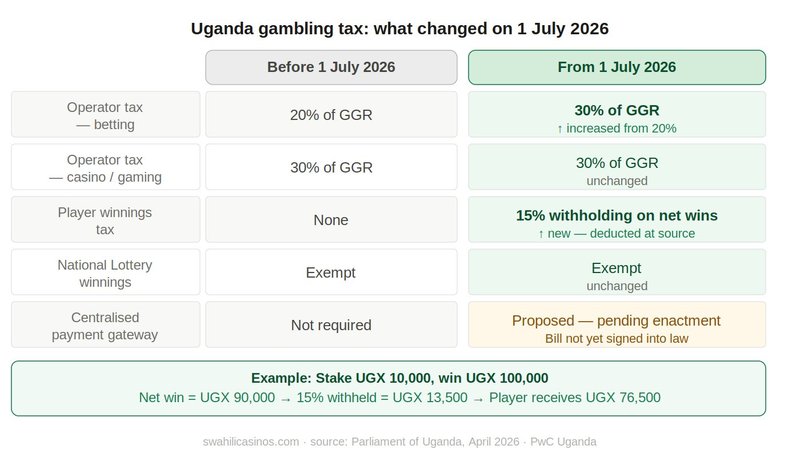
Uganda’s gambling tax structure is changing materially, effective 1 July 2026. With this page published in June 2026, Ugandan players are days away from the new regime. Here is what both measures mean in practice:
For Operators: Harmonised 30% GGR Tax
The Lotteries and Gaming (Amendment) Bill 2026, passed by Parliament in April 2026, introduces a uniform 30% tax on gross gaming revenue across all gambling categories — casino, sports betting, and gaming. Previously, betting operators were taxed at 20% GGR while casino operators already faced 30%.
The harmonisation removes the two-tier structure. Uganda now joins the group of African countries with the highest operator-level gambling tax rates in the region, at 30% of the total amount staked less payouts. Finance Minister Matia Kasaija presented the bill; it is now enacted law awaiting the 1 July implementation date.
For Players: 15% Withholding Tax on Net Winnings
The Income Tax (Amendment) Bill 2026, also passed in April 2026, introduces a 15% withholding tax on net player winnings from betting and gaming. This is deducted by the operator before the payout reaches the player’s mobile money account.
Key clarifications confirmed by PwC Uganda:
- The tax applies to net winnings — the winning amount minus the player’s original stake
- National Lottery winnings are exempt from the 15% withholding
- The operator deducts and remits the tax; players receive net-of-tax payouts automatically
In practical terms: if a player stakes UGX 10,000 and wins UGX 100,000, the net win is UGX 90,000. The 15% withholding applies to that UGX 90,000 — UGX 13,500 — leaving a payout of UGX 76,500.
The Proposed Centralised Payment Gateway
A separate proposal — the Tax Procedures Code (Amendment) Bill 2025 — would require all licensed operators to process bets and payouts through a single, centralised payment gateway licensed by the Bank of Uganda and linked to the URA’s electronic systems. As of June 2026, this proposal has not yet been enacted. The implementation timeline remains unclear, and industry commentators have flagged the dual-regulator structure (Bank of Uganda for the gateway, NLGRB for gambling operations) as a potential source of regulatory friction.
The gateway proposal matters to players because: if implemented, it would centralise transaction flows in a way that could affect how quickly deposits and withdrawals process, and create a formal record linking gambling transactions to players’ national identities.
Tax Comparison: Uganda vs the Region
| Country | Operator GGR Tax | Player Winnings Tax |
|---|---|---|
| Uganda (from 1 July 2026) | 30% | 15% on net winnings |
| Kenya | 15% | 5% on stakes + 5% on withdrawals |
| Tanzania | 25% | None at player level (varies) |
| South Africa | 6–7.5% (varies by licence) | None |
Uganda’s combined operator and player tax burden is among the highest in East Africa following this reform.
Uganda’s Gambling Market: Scale and Growth
The numbers are significant and often missed by competing content, which tends to treat Uganda as a minor market:
| Metric | Figure | Source |
|---|---|---|
| Gaming stakes FY 2025/26 | UGX 14.1 trillion projected (~USD 3.7bn) | NLGRB / Eagle Online, Feb 2026 |
| Total interactive GGR (2025) | USD 438 million | H2 Gambling Capital via iGaming Business |
| Sports betting share of interactive GGR | USD 328 million (75%) | H2 Gambling Capital |
| Offshore / illegal market share | USD 114.8 million (~26% of interactive total) | H2 Gambling Capital |
| Annual non-tax revenue growth (FY 19/20 to FY 24/25) | UGX 1.14bn → UGX 8.79bn (~8× increase) | NLGRB parliamentary testimony |
| Mobile money accounts (MTN + Airtel) | 34+ million active | Multiple sources |
| Internet penetration | 30%+ of population | NLGRB / industry estimates |
| Mobile internet share of traffic | 60%+ | Multiple |
Sports betting dominates. Slots and online casino are growing, particularly among the 25–40 demographic in Kampala and other urban centres. The offshore illegal market — operators running without NLGRB licences but accessible to Ugandan players via mobile internet — accounts for roughly a quarter of all online gambling activity. This is the market the NLGRB’s enforcement operations and the new centralised gateway proposal are directly targeting.
Payment Methods: MTN Mobile Money and the Uganda Gambling Stack
Uganda’s gambling market runs on mobile money. The dominant payment rails for online casino and betting deposits and withdrawals:
MTN Mobile Money (MTN MoMo) is the largest by subscriber count and the primary funding method for online gambling in Uganda. Deposits are instantaneous once confirmed on the MTN USSD or app; withdrawals from licensed operators typically arrive within minutes to a few hours for verified accounts, though first-time withdrawals above UGX 500,000 may take up to 24 hours.
Airtel Money is the main alternative, widely accepted at all significant Uganda-facing operators. Fees and transaction mechanics are broadly similar to MTN MoMo.
Africell Money is a smaller third option with over one million active subscribers, particularly relevant in areas with strong Africell network coverage.
Mobile money transaction limits that matter for casino players:
| Parameter | MTN MoMo | Airtel Money |
|---|---|---|
| Minimum transaction | UGX 500 | UGX 500 |
| Maximum single transaction | UGX 5,000,000 | UGX 5,000,000 |
| Maximum account balance | UGX 20,000,000 | UGX 20,000,000 |
| Deposit fees (casino side) | Typically none | Typically none |
| Withdrawal fees | MTN tariff applies (0.5–1.5% approx.) | Airtel tariff applies |
For players planning larger sessions: the UGX 5,000,000 single transaction cap (~USD 1,350) and UGX 20,000,000 balance cap are relevant practical constraints. Players expecting to withdraw large amounts may need to process multiple transactions.
The proposed centralised payment gateway, if enacted, could alter how these transactions are processed but would not eliminate the mobile money rails themselves.
The Responsible Gaming Directives 2025
The NLGRB’s most significant recent player-protection development is the Responsible Gaming Directives 2025, published in November 2025. These are not voluntary guidelines — they are binding compliance requirements for all NLGRB-licensed operators, both online and land-based.
Key provisions that directly affect players:
Cross-platform self-exclusion: A player who self-excludes at any one licensed operator triggers a notification to the NLGRB, which then maintains a Restricted Persons Register and informs all other licensees. Licensed operators must enforce the exclusion — this is a more robust system than the operator-level self-exclusion found in many markets, where a player excluded from one site can freely use another.
Marketing database removal: Within two business days of a self-exclusion, the operator must remove the player from all marketing contact lists. Promotional messaging must cease immediately.
Age verification: All online operators must verify player age at registration using national ID or passport — no registration without documented identity verification.
Mandatory responsible gaming messages: All operators must display responsible gaming warnings, and these are subject to NLGRB content standards.
Strict age checks: The 25-year minimum applies, with operators required to maintain records of age verification checks that are available for NLGRB inspection.
Enforcement: Operation Mashine Haramu and the Illegal Market
Uganda’s illegal gambling problem is significant. The NLGRB’s CEO has described offshore operators’ ability to reach Ugandan players via mobile advertising as “the main obstacle to effective player channelisation in Uganda’s gaming industry.”
On the land-based side, Operation Mashine Haramu — a joint NLGRB and Uganda Police Force enforcement campaign — has seized more than 6,000 illegal gaming machines across multiple districts as of mid-2026. Operators, suppliers, technicians, and manufacturers of illegal equipment have all been targeted. The operation is ongoing.
For online players, the enforcement picture is more nuanced: the NLGRB publishes a list of approved licensed operators on its website (lgrb.go.ug). Offshore operators running without NLGRB authorisation — including several large international sportsbook brands accessible in Uganda — operate outside the licensed framework. The proposed centralised payment gateway is partly designed to address this by making it harder for unlicensed operators to process Uganda-sourced transactions.
How to Verify a Licensed Casino or Betting Site in Uganda
The NLGRB maintains a public register of licensed operators. Verification steps:
- Visit lgrb.go.ug and navigate to the licensed operators list
- Check the operator’s own footer or terms and conditions for its NLGRB licence number
- Cross-reference the licence number against the NLGRB register
- Confirm that MTN Mobile Money and Airtel Money are offered — operators running without NLGRB licences cannot integrate directly with Ugandan mobile money infrastructure in the same way licensed operators do
- Confirm the age verification process is in place — a platform that allows registration without identity verification is not operating within NLGRB requirements
What the July 2026 Tax Changes Mean for Players Practically
To be direct about the immediate impact: players will receive smaller withdrawals on winning sessions from 1 July 2026 than they received before that date, because the 15% withholding tax on net winnings will be deducted at source.
Operators should be communicating this change. If your casino or betting site has not updated its withdrawal terms or cashier documentation to reflect the 15% deduction by 1 July 2026, that is worth querying with their support team before your next session.
National Lottery winnings remain exempt. Players who primarily participate in Uganda’s National Lottery are not affected by the withholding tax.
The higher 30% GGR tax on operators will not be directly visible to players as a line item, but it reduces the revenue available to operators for bonuses, promotions, and payout margins — so its indirect effect on the player experience is real even if the mechanism is invisible.
Responsible Online Gambling in Uganda
The NLGRB is the primary responsible gambling authority in Uganda. Its responsible gaming resources are available at lgrb.go.ug.
Under the Responsible Gaming Directives 2025, all licensed operators must provide:
- Self-exclusion tools (cross-platform, registered with the NLGRB)
- Deposit limits and loss limits
- Reality checks and session time alerts
- Age verification at registration
For players concerned about their gambling, the NLGRB’s Restricted Persons Register means self-exclusion with one licensed operator is effective across all licensed operators in Uganda — a significantly stronger protection than exists in many other markets.
Hopeline Uganda: +256 800 200 113 (for gambling-related support)
Gambling is entertainment, not a source of income. Set a budget before you play, and do not gamble with money you need for living expenses.
Frequently Asked Questions
Is online gambling legal in Uganda? Yes. Online gambling is legal for operators licensed by the National Lotteries and Gaming Regulatory Board (NLGRB) under the Lotteries and Gaming Act 2016. Players using NLGRB-licensed platforms are operating within the legal framework.
What is the minimum gambling age in Uganda? 25 years for sports betting, casino gaming, and bingo. This is one of the highest minimum gambling ages in the world and is set by the Lotteries and Gaming Act 2016. The National Lottery is the only exception, open to those aged 18 and above. Many sources incorrectly state the minimum age as 18.
Who regulates online gambling in Uganda? The National Lotteries and Gaming Regulatory Board (NLGRB), established under the Lotteries and Gaming Act No. 7 of 2016. Its website is lgrb.go.ug.
What taxes apply to gambling winnings in Uganda from July 2026? A 15% withholding tax on net winnings (winnings minus the original stake) applies from 1 July 2026, deducted by the operator before payout. National Lottery winnings are exempt from this tax.
Can I use MTN Mobile Money to deposit at online casinos in Uganda? Yes. MTN Mobile Money and Airtel Money are the primary payment methods at all major licensed Uganda-facing operators. Minimum transaction: UGX 500. Maximum single transaction: UGX 5 million.
What is the NLGRB’s Restricted Persons Register? A cross-platform self-exclusion register maintained by the NLGRB under the Responsible Gaming Directives 2025. If a player self-excludes with one licensed operator, the NLGRB notifies all other licensed operators, who must enforce the exclusion. It is more comprehensive than the operator-by-operator self-exclusion systems found in most markets.
Are offshore casinos legal in Uganda? Offshore operators without NLGRB licences are not authorised to operate in Uganda’s regulated market. Many are accessible to Ugandan players via mobile internet regardless, and the NLGRB has identified this as its primary enforcement challenge. The proposed centralised payment gateway is partly intended to address it.
What is Operation Mashine Haramu? A joint enforcement operation by the NLGRB and Uganda Police Force targeting illegal gaming machines. Over 6,000 illegal devices have been seized across multiple districts as of mid-2026. The operation is ongoing.
Affiliate disclosure: SwahiliCasinos.com earns referral commissions from some operators linked from this site. This does not influence editorial content. Regulatory and tax information is sourced from NLGRB publications, parliamentary records, and verified industry sources. Last verified: June 2026. Gambling regulations and tax rates change frequently — verify current status via lgrb.go.ug before depositing.