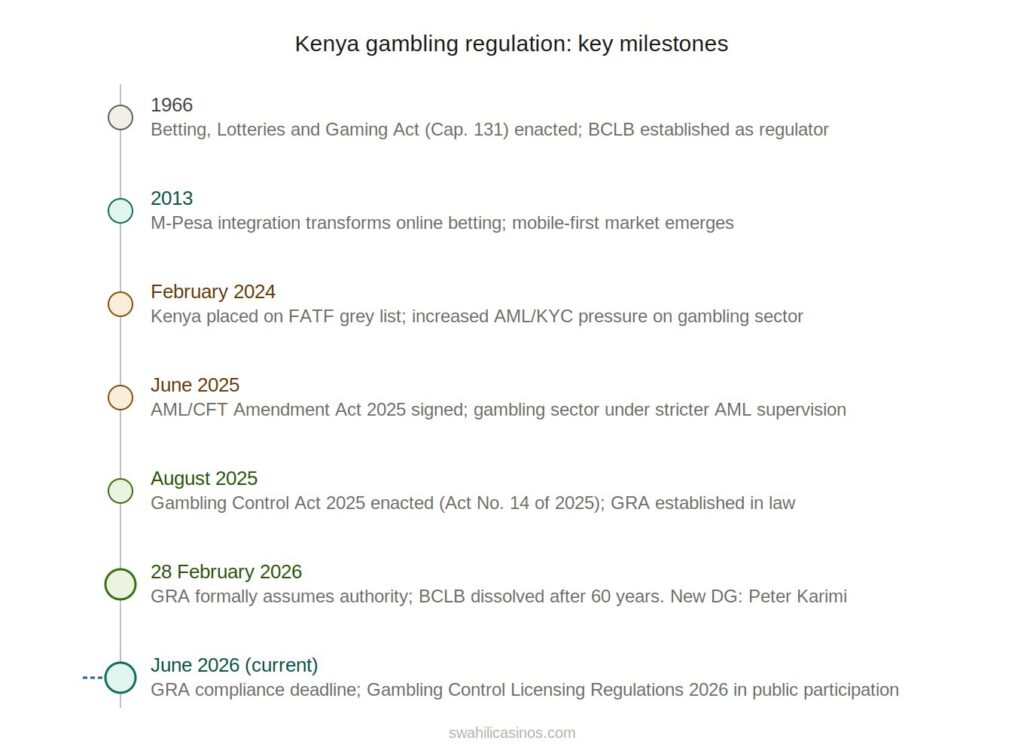
Online gambling in Kenya is legal, regulated, and undergoing its most significant structural change in decades. As of 28 February 2026, regulatory authority over the sector formally transferred from the Betting Control and Licensing Board (BCLB) — which governed Kenya’s gambling industry since 1966 — to the newly established Gambling Regulatory Authority (GRA), the statutory body created by the Gambling Control Act 2025. Existing licensed operators continue to operate under current licences while the GRA finalises its new licensing framework, which must be fully operational before the current licensing cycle closes in June 2026.
For players, the short answer is: Kenya’s leading licensed platforms are safe to use, M-Pesa remains the dominant payment method, and the incoming GRA framework introduces stronger player protections than existed under the previous regime. For those researching the market in depth, the full picture is more nuanced — and that nuance is what this page covers.
Is Online Gambling Legal in Kenya?
Yes. Online gambling is legal in Kenya for operators holding a valid licence from the GRA (previously the BCLB). The legal foundation for regulated gambling in Kenya has shifted from the decades-old Betting, Lotteries and Gaming Act (Cap. 131) to the Gambling Control Act 2025, which received presidential assent from President William Ruto on 20 August 2025 and came into force on 16 August 2025.
The Act explicitly provides for online gambling licences as a distinct category, alongside licences for bookmaking, casino gaming, lotteries, and prize competitions. No licensed operator needs to rely on regulatory ambiguity about whether online activity is permitted — it is specifically regulated and licensed.
Players in Kenya are legally permitted to use licensed platforms. The Act and draft 2026 regulations place the licensing and compliance obligations on operators, not on players, which is consistent with how most regulated markets work globally.
Who Regulates Online Gambling in Kenya?
The Gambling Regulatory Authority (GRA)
The GRA formally assumed authority over Kenya’s gambling sector on 28 February 2026. It is structured as an independent state corporation with broader enforcement powers than the BCLB it replaced.
Key appointments already confirmed:
- Chairperson: Joseph Kirui Limo (former MP), appointed October 2025
- Director General: Peter Maina Karimi, who took over from outgoing DG Peter Mbugi at a formal handover ceremony
The GRA’s current priorities, as stated by DG Karimi in parliamentary testimony, are:
- Building real-time monitoring systems to track betting activity across both online and land-based platforms
- Expanding the GRA’s workforce to approximately 200 specialists
- Potentially absorbing gambling revenue oversight functions currently held by the Kenya Revenue Authority (KRA)
- Developing a framework for a national lottery
The Gambling Control Licensing Regulations 2026
The GRA has published proposed licensing regulations — the Gambling Control (Licensing) Regulations 2026 and the Gambling Control (Conduct of Gambling Operations) Regulations 2026 — currently in public participation as of mid-2026. These regulations will define the specific requirements operators must meet to hold a licence under the new framework. The June 2026 compliance deadline means operators who cannot meet the new standards face difficulty renewing or obtaining licences.
Other Regulatory Stakeholders
Operating in Kenya’s gambling sector involves more than just the GRA. The full institutional picture:
| Authority | Role |
|---|---|
| Gambling Regulatory Authority (GRA) | Licensing, monitoring, enforcement |
| Kenya Revenue Authority (KRA) | Tax collection on GGR, excise duties |
| Financial Reporting Centre (FRC) | AML/CFT monitoring, suspicious transaction reporting |
| County Governments | The Gambling Control Act 2025 establishes a two-tier model; county governments have concurrent jurisdiction over certain gambling activities |
What the Gambling Control Act 2025 Changed
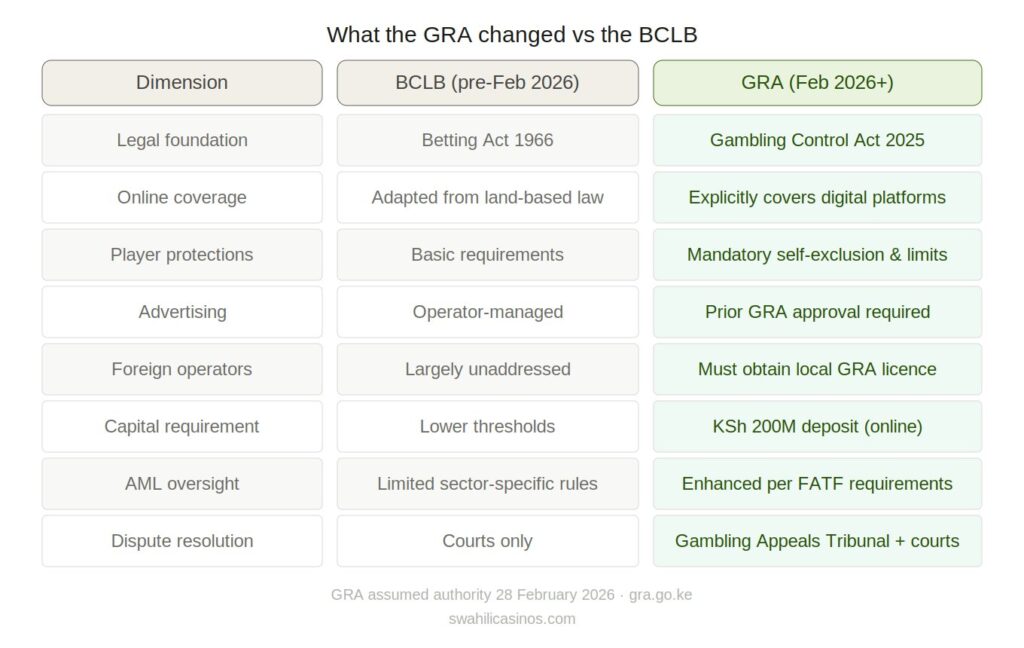
The Gambling Control Act 2025 is not a minor update — it replaces a legal framework that dated to 1966 and had become structurally inadequate for a mobile-first, predominantly online market. The provisions most relevant to players and operators:
Local ownership: Licensed gambling companies must have at least 30% Kenyan ownership. This provision is intended to retain a greater share of industry profits within the country and has implications for which international operators can access the Kenyan market directly.
Capital requirements: Online gambling and lottery operators must hold a security deposit of KSh 200 million (approximately USD 1.55 million). This is a deliberate barrier to entry designed to exclude undercapitalised operators.
Player protections: Operators must integrate responsible gambling features — self-exclusion, deposit limits, reality checks — into their platforms as a technical condition of licensing, not merely as policy. Systems must be capable of enforcing player-set limits automatically.
Identity verification: Identity verification is mandatory at registration for online platforms. This tightens the registration process compared to previous practice on some platforms.
Real-time monitoring: Operators must integrate with the GRA’s real-time monitoring system to allow direct regulatory supervision of online transaction flows.
Advertising restrictions: Advertisements targeting vulnerable groups — particularly minors — face strict controls. All gambling advertisements require prior approval from the GRA under the proposed 2026 advertising regulations. Content that presents gambling as a financial solution is specifically prohibited. Time restrictions apply to broadcast advertising.
Foreign operators: Offshore gambling companies targeting Kenyan players must now obtain local GRA authorisation, comply with domestic reporting obligations, and implement geo-fencing systems. The practical impact: offshore platforms that were operating in a regulatory grey area face a binary choice between local compliance or withdrawal from the market.
Dispute resolution: A Gambling Appeals Tribunal has been established to review regulatory decisions — licensing disputes, enforcement actions — reducing reliance on the courts.
Taxation: What Players Actually Pay
Kenya’s gambling tax structure has been in flux. As of mid-2026, the relevant taxes for players using online platforms are:
- Excise duty on stakes: The Finance Act 2025 introduced a 5% excise duty on betting stakes deposited into betting wallets.
- Withdrawal tax: A 5% tax applies on withdrawals from betting wallets.
- GGR tax on operators: Operators pay a 15% tax on Gross Gaming Revenue to the KRA. This is an operator-level tax, not a player-facing one, but it influences the odds and margins platforms offer.
Note: A proposed 16% VAT on fees charged by M-Pesa and Airtel Money — which would affect all mobile money transactions, not just gambling — was under discussion as of mid-2026. If passed and applied to gambling deposits and withdrawals, it would represent an additional cost increase for players using mobile money to fund accounts.
Kenya and the FATF Grey List
One factor that distinguishes Kenya’s gambling market from simpler regulatory contexts: Kenya has been on the Financial Action Task Force (FATF) grey list — formally, “Jurisdictions under Increased Monitoring” — since February 2024. As of the February 2026 FATF plenary, Kenya remains on this list.
Grey-listing does not make gambling illegal, and it does not directly restrict players. What it does create:
- Stricter KYC requirements for licensed operators. Under the Anti-Money Laundering and Combating of Terrorism Financing Laws (Amendment) Act 2025, operators must implement enhanced due diligence on high-risk customers, politically exposed persons, and large transactions.
- More frequent suspicious transaction reporting to the Financial Reporting Centre (FRC).
- Tighter document verification at withdrawal for larger amounts — players should expect to provide more documentation when cashing out significant sums than they might at offshore-licensed platforms.
- Increased scrutiny on international transactions — relevant for players who use international cards or e-wallets alongside mobile money.
Kenya has taken concrete steps toward removal from the grey list: the AML/CFT Amendment Act 2025 was signed into law in June 2025, and the broader Gambling Control Act 2025 brings the gambling sector more squarely under the AML supervision framework. The FATF specifically cited inadequate monitoring of casinos and gambling companies as one of Kenya’s deficiencies when it listed the country in 2024, so the GRA transition is directly responsive to that concern.
How Mobile Money Shapes Kenyan Online Gambling
Kenya’s gambling market was built on M-Pesa. The connection between Safaricom’s mobile money infrastructure and the growth of online betting is foundational — before M-Pesa, betting required physical visits to shops; after M-Pesa, the entire transaction cycle moved to mobile within a few years. This is not a peripheral feature of the market. It is the primary payment infrastructure.
Current state of mobile money for gambling (mid-2026):
M-Pesa remains dominant, with 40 million active monthly users across the Kenyan economy as of March 2026, according to Tribuna.com. Its market share of Kenya’s mobile money sector has declined from a peak of approximately 98% to around 89% as of December 2025, with Airtel Money gaining ground partly on the basis of lower fees.
Airtel Money is the primary alternative to M-Pesa for gambling deposits and withdrawals. Its lower transaction fees are relevant given the excise duty structure on gambling — fee savings on payment infrastructure compound with the existing tax on stakes.
What this means for players using these platforms: Licensed online casinos in Kenya must hold an M-Pesa paybill number to accept M-Pesa payments directly. This is one of the practical reasons why licensing matters to players — unlicensed offshore platforms cannot legally access M-Pesa payment infrastructure directly, which means their deposit and withdrawal processes are typically slower, more expensive, or routed through intermediaries.
The Market: Kenya’s Online Gambling in Numbers
Kenya ranks third in Sub-Saharan Africa by gambling market size, behind South Africa and Nigeria. Selected verified figures from credible sources:
| Metric | Figure | Source |
|---|---|---|
| Total gambling market revenue | Projected USD 831m–1.22bn in 2025 | Statista; Slotegrator |
| Online/mobile gambling revenue | USD 153m (2024) | iGaming market research |
| Market growth rate | 12.3% CAGR 2025–2031 | 6Wresearch |
| M-Pesa monthly active users | 40m (March 2026) | Tribuna |
| Share of internet access via mobile | Over 85% | Multiple sources |
| Licensed operators (2025–26 cycle) | 99 companies (per BCLB, July 2025) | BCLB announcement |
Sports betting dominates by volume — a 2021 GeoPoll survey found 96% of gamblers placed bets by mobile phone, and 37% bet on sports weekly. Football (soccer) is the primary betting category, with Kenyan punters covering both local leagues and international competitions.
How to Identify a Legally Licensed Casino in Kenya
Under the outgoing BCLB framework, the public register of licensed operators was available at the BCLB website. As the GRA assumes full authority, the relevant verification point shifts to the GRA’s public listings. The GRA’s website is gra.go.ke.
Practical checks before depositing:
- Look for the operator’s licence reference in its terms and conditions or footer. Licensed operators operating in Kenya are required to display this.
- Verify against the GRA/BCLB public register. If an operator claims a licence but cannot be found on the register, treat it as unlicensed.
- Confirm M-Pesa availability. Unlicensed operators cannot hold Safaricom paybill numbers, so if a platform claims to accept M-Pesa but cannot show a registered paybill, the claim should be verified carefully.
- Check for responsible gambling tools. Under the Gambling Control Act 2025, all licensed operators are required to provide self-exclusion options, deposit limits, and reality checks. Their absence on a platform is a red flag regardless of claimed licensing status.
What the GRA Transition Means for Players Right Now (June 2026)
The transition is ongoing, which creates some genuine uncertainty worth naming directly:
Existing licences remain valid. The 99 operators listed by the BCLB for the 2025–26 cycle continue operating under their existing licences until those licences expire. Players using these platforms are not in legal jeopardy.
New licence applications. The BCLB suspended new licence applications during the transition period. The GRA is now drafting its new licensing regulations, with a June 2026 deadline for the framework to be operational. What this means in practice: the number of GRA-licensed operators in the market is largely fixed at the BCLB-era cohort until the GRA opens its full licensing pipeline.
Compliance upgrades are happening. Operators are currently implementing the technical requirements of the new framework — real-time monitoring integration, enhanced KYC, responsible gambling tools. Players may notice more robust verification requirements than a year ago.
Advertising environment is tightening. The proposed 2026 advertising regulations, which require prior regulatory approval for all gambling advertisements, will significantly change how operators market to Kenyan players. The advertising environment of 2026 is more restrictive than 2024–2025.
Responsible Gambling in Kenya
The Gambling Control Act 2025 places responsible gambling obligations on operators, not players. But the practical tools that licensed operators must now provide are relevant to anyone playing:
- Self-exclusion: Licensed platforms must provide self-exclusion mechanisms that are technically enforceable — the system must be capable of blocking access, not merely offering it as an option.
- Deposit limits: Players can set their own limits; licensed platforms must enforce these automatically.
- Reality checks: Time-based session alerts must be available.
- Underage access controls: Age verification at registration is mandatory.
If you are concerned about your gambling habits, the Gambling Regulatory Authority of Kenya (GRA) — gra.go.ke — is the primary regulatory body for complaints and responsible gambling referrals. The GRA’s establishment of a Gambling Appeals Tribunal also provides a formal mechanism for players to challenge operator decisions.
Gambling is entertainment, not a source of income. Set a budget before you play and stick to it.
Frequently Asked Questions
Is online gambling legal in Kenya? Yes. Online gambling is legal for operators holding a valid licence from the Gambling Regulatory Authority (GRA), which formally replaced the BCLB as Kenya’s gambling regulator on 28 February 2026.
Which regulator now governs gambling in Kenya? The Gambling Regulatory Authority (GRA), established under the Gambling Control Act 2025. Its website is gra.go.ke. The BCLB, which previously regulated the sector, has been dissolved.
Can I use M-Pesa to deposit at online casinos in Kenya? Yes, if you are using a licensed operator. Licensed platforms in Kenya hold Safaricom paybill numbers that enable direct M-Pesa integration. Airtel Money is an alternative available on most licensed platforms. The best M-Pesa online casinos in Kenya are covered in our dedicated guide.
What taxes apply to gambling in Kenya? Players face a 5% excise duty on betting stakes and a 5% tax on withdrawals from betting wallets, under the Finance Act 2025. Operators separately pay a 15% tax on gross gaming revenue, which affects their operating margins.
What does Kenya’s FATF grey list status mean for players? Kenya has been under FATF increased monitoring since February 2024. For players, this translates to stricter KYC requirements — expect more identity documentation requests, particularly for larger withdrawals. It does not affect the legality of using licensed platforms.
What is the minimum gambling age in Kenya? The Gambling Control Act 2025 sets the minimum age at 18. There were proposals in parliament in 2025 to raise this to 21, but these had not been enacted as of mid-2026.
Are offshore casinos legal in Kenya? The Gambling Control Act 2025 and proposed 2026 regulations require offshore operators targeting Kenyan players to obtain local GRA authorisation and comply with domestic reporting and geo-fencing requirements. Offshore platforms operating without this authorisation are not operating within the legal framework, regardless of whether they hold licences from other jurisdictions.